AI Edit
Product Manager · AI SaaS · Eklipse.gg

From Friction
to Viral-Ready

Product Eklipse.gg — AI Video Editing
Company PT Main Games Indonesia, Jakarta
Category SaaS · AI Feature · Gaming
Timeline Beta in 8 weeks · 15-month growth
+30%
Revenue Growth
+25%
Active User Growth
70%
Feature Engagement
<3 min
Edit Time (from 30+ min)
01

Executive Summary

Eklipse.gg had built an AI-powered clip detection engine that could extract highlight moments from gaming streams — but only 2–5% of users were actually sharing those clips. The product was generating value that users were not realizing. The pipeline broke at the editing and publishing stage, not at discovery.

As Product Manager, I scoped and shipped the AI Edit feature — an automatic editing layer that applies memes, SFX, VFX, and multilingual captions to highlight clips with a single trigger. The goal was to close the gap between "clip identified" and "clip shared" by removing the editing barrier entirely.

The result: feature engagement grew from 30% to 70% over 15 months, revenue increased 30%, active users grew 25%, and editing time collapsed from 30+ minutes to under 3 minutes. AI Edit became the platform's primary retention and conversion driver.

AI Product Feature PM Growth Loop Lean UX Gaming · SaaS · Jakarta

Project Brief
Product Eklipse.gg AI Edit
Role Product Manager
Company PT Main Games Indonesia
Tenure Oct 2023 – Jun 2025
Starting Point 2–5% clip share rate · 30% engagement
End State 70% engagement · +30% revenue
Tools Figma · Jira · Agile Scrum
02

Problem Statement

Eklipse had solved the hardest technical problem — finding the best moments inside a gaming stream. But the product was stalling at the next critical stage: creators were not turning those clips into shareable content. The drop-off between clip generation and publishing was the product's primary growth blocker.

Clip Share Rate
2–5%
Only 2–5% of users who received AI-highlighted clips actually shared them. The majority stopped at preview — indicating a friction point in the editing and publishing pipeline.
Feature Engagement
30%
Initial feature engagement at beta was 30%. The clip engine was active but the editing layer was absent — users had highlights but no efficient path to a publish-ready output.
Editing Time
30+ min
Manual editing in tools like CapCut required 30+ minutes per clip for a polished output. Most creators, especially casual streamers, abandoned the process before completion.
Content Quality
Raw
Unedited highlight clips lacked the memes, SFX, captions, and visual polish that drive engagement on TikTok, Reels, and Shorts. Raw clips were not performing on social platforms.
Tool Complexity
High
Existing editing tools — CapCut, Adobe Premiere — had steep learning curves and were not optimized for gaming content. The skills gap was a structural barrier for casual creators.
Root Cause
Gap
The product identified great moments but delivered them in an unusable state. The missing layer was automated editing — closing the loop from highlight to publish-ready clip without user effort.
Strategic Diagnosis

"Eklipse had the hardest part solved — moment detection. The gap was the last mile: editing. Users needed a path from clip to share that required zero editing skill and less than 3 minutes of effort."

03

Research & Insights

🎮 User Interviews (12 Creators)
Conducted interviews with 12 active creators across Twitch and Discord. Consistently heard: creators wanted clips that "look viral-ready without editing." They were not asking for better clip detection — they were asking for the editing to be done for them. The bottleneck was post-detection, not detection.
📊 Analytics — Funnel Drop-off
Platform analytics confirmed the interview signal: the largest user drop-off occurred at the editing and sharing stage, not at the highlight preview stage. Users were engaging with clips but abandoning before export. This indicated a tool friction problem, not a content quality problem.
👥 Two Distinct Personas Identified
The Casual Streamer — wants quick, funny clips for Discord and group chats. Zero patience for editing. Values speed above polish. Needs a one-tap solution.

The Growth Seeker — wants polished, engagement-optimized edits for TikTok. Values output quality. Willing to spend a few minutes if the result is strong and shareable.
📱 Discord as Primary Engagement Channel
Discord was identified as the most active daily touchpoint for gaming creators — more than the web app itself. This informed both the validation strategy (beta via Discord) and the product's social sharing architecture: clips needed to be Discord-native in format and one-tap in effort.
✗ What Creators Were Experiencing
30+ min editing time in CapCut or Premiere
Clips felt raw — no memes, SFX, or captions
Vertical format conversion was a manual step
No multilingual caption support for global audiences
Regeneration was not possible if output was poor
✓ What Creators Actually Needed
One-click edit that produces a shareable clip
Meme overlays and SFX auto-applied to key moments
Vertical format ready for TikTok, Reels, Shorts
Multilingual auto-captions for broader reach
Easy regeneration if the first output misses the mark
04

Product Hypothesis

The feature scope and success criteria were defined upfront as a testable hypothesis — ensuring that every execution decision could be measured against a specific predicted outcome.

IF we build these capabilities:
One-click AI Edit trigger that generates a publish-ready clip from any highlighted moment — no manual editing required
Auto-applied meme overlays, SFX, and VFX based on detected game moment type and community preference patterns
Multilingual auto-caption generation applied to every exported clip as a default output
Regeneration flow with improved UI placement — allowing users to retry with a different style if the first output does not meet expectations
Preview-first architecture so users see the edited result immediately before committing to export or share
→
THEN we expect these outcomes:
Clip share rate increases significantly as the editing barrier is removed and output quality improves to social-platform standards
Feature engagement grows from baseline 30% as both casual and growth-oriented creators find the tool meets their distinct use cases
Editing time collapses from 30+ minutes to under 3 minutes — removing the primary behavioral barrier to creator content output
Premium conversion rate increases as users experience the quality differential between free and watermark-free HD exports
AI Edit becomes a product differentiator versus CapCut and Adobe — creating a defensible, gaming-specific editing advantage
05

Strategy & Framework

The project was structured using the company's internal Lean UX process — a continuous loop of concept testing, user adoption measurement, and engagement-driven iteration. This was combined with Agile Scrum for sprint execution and a disciplined stakeholder communication rhythm.

Lean UX Process
DDiscover — user interviews + analytics review
DDefine — MVP scope + success metrics
BBuild — BRD, FSD, design handoff
TTest — Discord beta + structured feedback
→Iterate on adoption + engagement data
Agile Scrum Execution
◆Sprint planning with prioritized backlog
◆Daily stand-ups with dev + design
◆BRD/FSD maintained as source of truth
◆Release validation against documented specs
◆Retrospectives after each sprint cycle
PM Responsibilities
◆MVP scope definition + prioritization
◆Stakeholder communication (internal + partners)
◆ML/AI team alignment on speed/quality/cost
◆Premium tier scoping with monetization team
◆Backlog grooming + release management
06

Execution Process

Phase 1 — Problem Framing & User Discovery
Root Cause Alignment + Persona Definition
Conducted 12 creator interviews via Twitch and Discord. Synthesized findings into two validated personas: the Casual Streamer (one-tap clips for socials) and the Growth Seeker (polished edits for TikTok reach). Cross-referenced interview data with platform analytics to confirm the editing stage as the primary drop-off point. Framed the product opportunity as a "last-mile editing" problem, not a detection problem.
Phase 2 — MVP Scoping & Documentation
BRD, FSD, and Feature Specification
Defined MVP scope: single-clip input → meme overlay + VFX + multilingual caption output. Produced full BRD and FSD documents covering functional requirements, acceptance criteria, ML model integration specifications, and UI flows. Prioritized vertical-format output to align with TikTok/Reels/Shorts distribution context. Aligned with ML/AI team on the tradeoff between generation speed, visual quality, and compute cost per clip.
Phase 3 — Wireframes, Prototypes & Design Handoff
UI Architecture + Developer Alignment
Partnered with UX Designer to build low-fi wireframes focused on three principles: Simplicity (one-click trigger), Preview-first (immediate result visibility), and Regeneration (easy retry for suboptimal outputs). Built an interactive prototype tested with 5 early users — 4 of 5 preferred it over manual editing tools. Conducted developer handoff with full FSD to ensure implementation matched documented specifications.
Phase 4 — Beta Validation via Discord
Closed Beta + Structured Feedback Loop
Released AI Edit Beta to a closed Discord channel. Collected structured feedback through emoji voting on AI-generated clips and open-ended commentary. Key findings: creators wanted more meme template variety, the regenerate button needed repositioning for discoverability, and multilingual captions were disproportionately valued — especially for creators targeting non-English audiences. All three findings were prioritized in the next sprint.
Phase 5 — Iteration, Refinement & Scale
Production Launch + Continuous Improvement
Added expanded meme pack library and SFX overlays based on community voting data. Repositioned the regenerate button to a primary action position in the UI — reducing abandonment at the review stage. Shipped a loading animation on the generation screen (a significant UX-level fix): adoption of the generation step increased 30% as users who previously abandoned during load time now completed the flow. Tracked 15-month engagement trajectory from 30% to 70%.
07

Design Evolution

Three key UI moments defined the AI Edit user flow — each resolved a specific friction point identified through user research and beta feedback. The interface decisions below directly correlate to engagement and adoption metrics.

🎬
UI State 1 — Modal Trigger: Start AI Edit The entry point for the AI Edit flow. Users activate editing from their existing highlight clips via a modal overlay — a deliberate design choice to keep the trigger low-commitment and reversible.
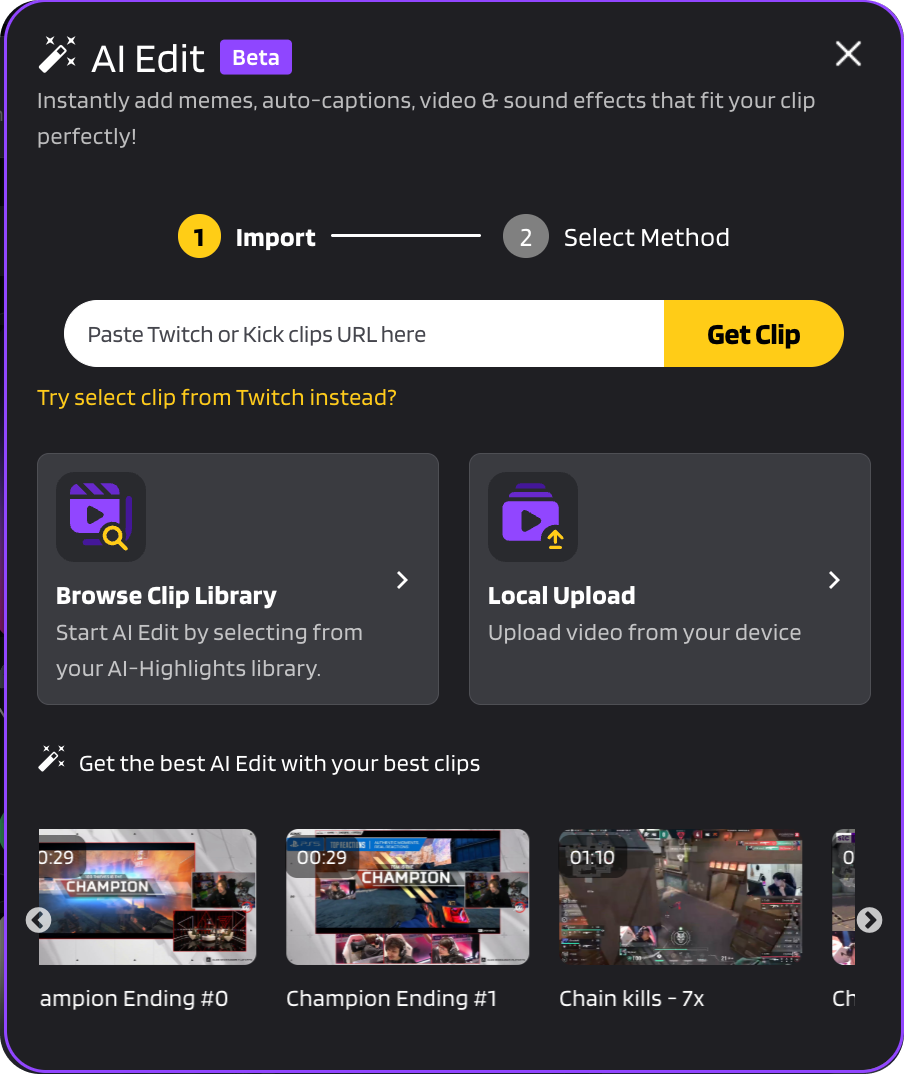
Eklipse AI Edit modal trigger UI
Design Decision The modal approach reduces perceived commitment — users are not navigating away from their clip library. One trigger, immediate response. This lowered the activation threshold for both casual and growth-oriented personas equally.
⏳
UI State 2 — Editing Page: The Load-Time Problem The AI generation step required meaningful compute time. Without visual feedback, users interpreted the blank loading state as an error and abandoned before the output completed.
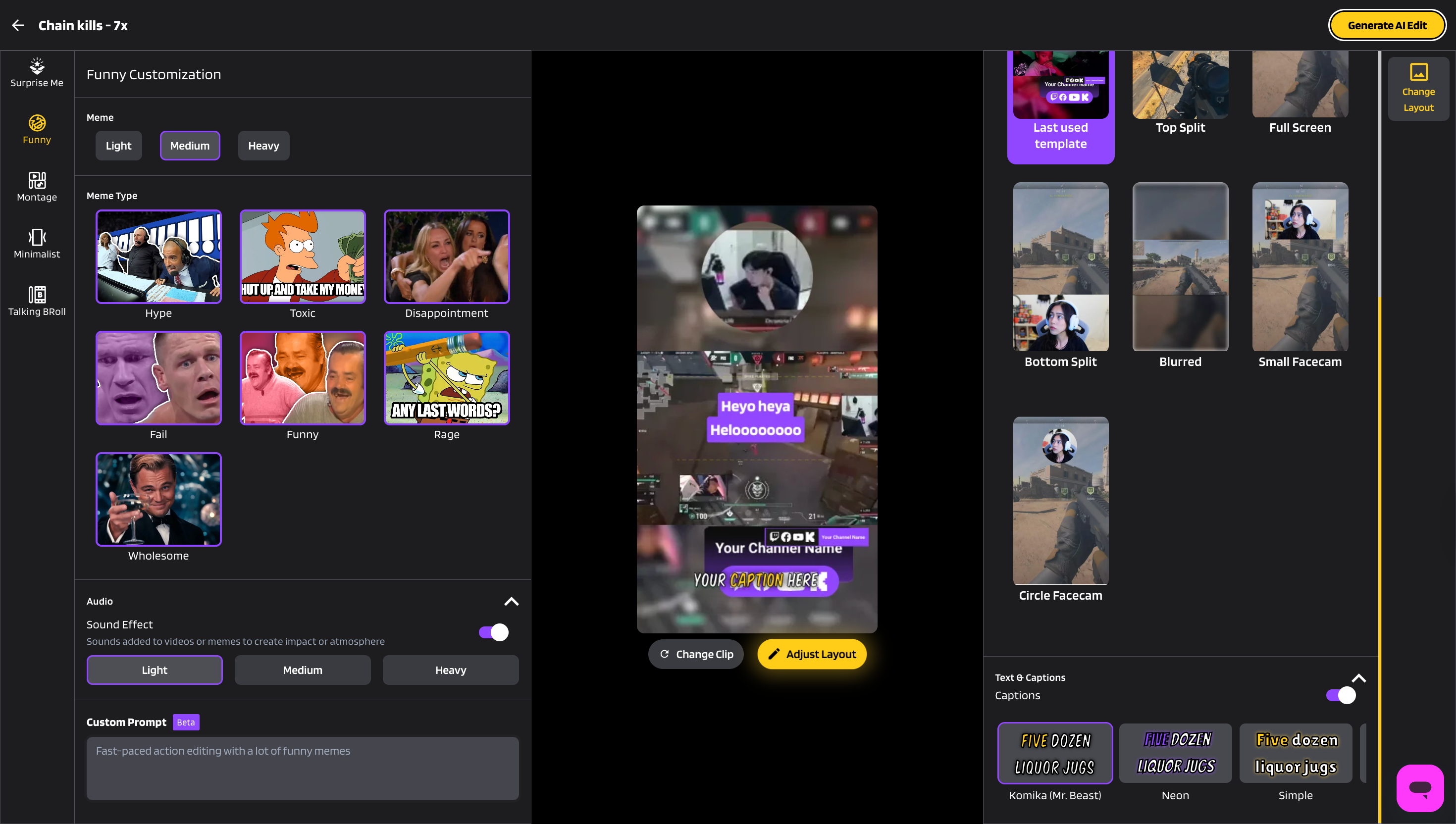
Eklipse AI Edit editing page loading state
Friction Found Users were abandoning the flow during AI generation — not because the output was poor, but because the loading state was empty and unresponsive. This was a UX failure masquerading as a product failure. The fix was a loading animation, not an engineering optimization.
✅
UI State 3 — Loading Animation: The Fix Adding a progress animation during the AI generation phase communicated that the system was working. The result was measurable and immediate.
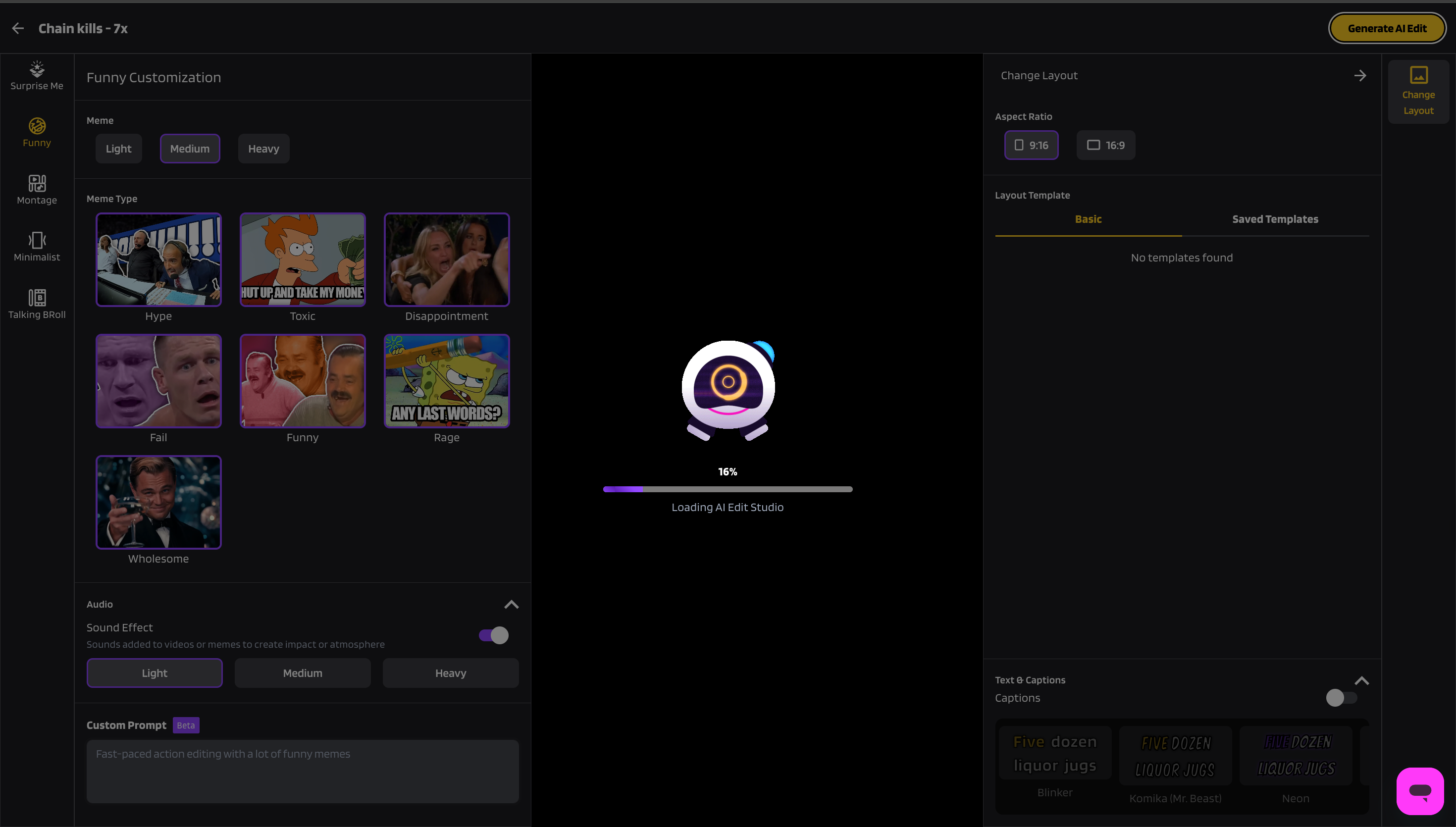
Eklipse AI Edit loading animation state
Impact A single UX change — adding a loading animation — produced a 30% increase in users completing the generation step. This is a clear example of a trust signal intervention: users were not abandoning because of the wait, they were abandoning because of uncertainty. The animation resolved the uncertainty, not the wait time.
🎮
UI State 4 — Final Output: Publish-Ready AI Clip The resolved state — a fully edited, vertically formatted, caption-applied clip ready for direct sharing to TikTok, Discord, Reels, or Shorts without any additional editing.
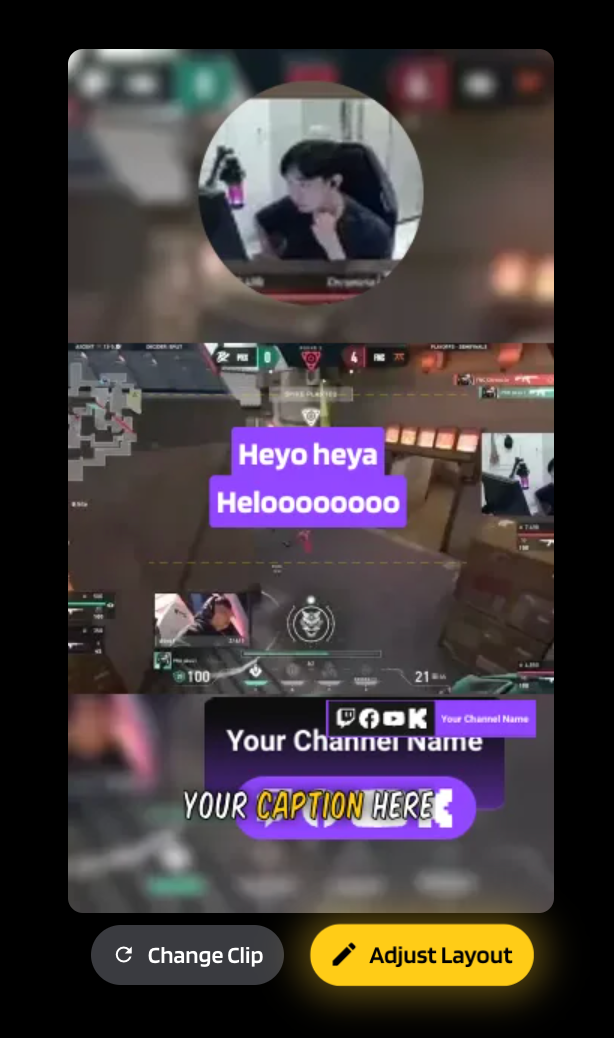
Eklipse AI Edit final output clip
Product Goal Achieved The output state is the product promise fulfilled: a gaming highlight, processed by AI, styled with memes and SFX, captioned, and formatted for vertical social platforms — delivered in under 3 minutes from a 30+ minute manual baseline. This is the "last mile" closed.
+30%
Adoption from loading animation
4/5
Prototype preference vs. CapCut
<3 min
Edit time vs. 30+ min baseline
8 wks
Discovery to beta launch
08

Engagement Metrics

The following metrics track AI Edit's performance from initial beta through the 15-month post-launch growth period. All figures reflect platform analytics and stakeholder reporting from the Eklipse.gg product team.

Before — Baseline State
Clip Share Rate
2–5%
Feature Engagement
30%
Editing Completion
Low
Generation Step Adoption
Abandoned
vs
After — 15-Month Growth
Clip Share Rate
+30% Social Shares
Feature Engagement
70%
Editing Completion
High
Generation Step Adoption
+30% from animation fix
Metrics Interpretation

"The 30–70% engagement journey was not the result of a single shipping moment. It was the compounded output of five iterative phases — each one removing a specific friction layer between the user and a shared clip."

09

Outcome & Impact

Business
Revenue Growth
+30%
Revenue increase directly attributed to AI Edit adoption and associated Premium tier conversion driven by feature usage.
Product
Active User Growth
+25%
New user acquisition supported by 5–7% MoM growth. AI Edit positioned Eklipse as the go-to gaming content creation tool in the creator community.
Engagement
Feature Engagement
70%
Grew from 30% at beta launch to 70% at 15 months. The product became a platform-level engagement anchor, not a secondary feature.
Efficiency
Editing Time
<3 min
Collapsed from a 30+ minute manual process to under 3 minutes — eliminating the behavioral barrier for casual and high-frequency creators alike.
Conversion
Premium Sign-ups
1–5%
Premium conversions directly attributable to AI Edit usage — watermark-free HD output as the primary conversion trigger from free to paid tier.
Delivery
Beta Launch
8 wks
Discovery to beta launch in 8 weeks. Lean UX process and clean BRD/FSD documentation enabled fast, aligned development sprint execution.
Competitive Differentiation
AI Edit created a defensible, gaming-specific editing advantage that CapCut and Adobe could not replicate without deep gaming content intelligence. One-click, gaming-native editing for vertical social formats was a genuine market gap — and Eklipse now occupies it.
Creator Retention Driver
Feature engagement at 70% means AI Edit became a habitual behavior, not a one-time trial. Creators who adopted the feature returned repeatedly — making it the strongest retention signal in the platform's usage data and a core stickiness mechanic.
Monetization Bridge
The quality differential between free (watermarked, standard resolution) and Premium (HD, watermark-free) AI Edit output created a natural, feature-led upgrade path. Premium conversions driven directly by AI Edit usage validated the feature as a monetization lever, not just a retention tool.
Platform-Level Signal Shift
Eklipse's positioning shifted from "gaming clip detection tool" to "end-to-end gaming content creation platform." AI Edit was the product layer that justified this repositioning — giving the platform a reason to exist beyond the highlight feed and a story to tell in the creator community.
10

Key Learnings

01
The Last Mile Is Often the Hardest Product Problem
Eklipse had solved moment detection — a technically hard problem — and still had near-zero sharing. The last mile (detection → shareable clip) was the actual product problem. This is a recurring pattern in AI-powered products: the intelligence layer is built first, but user value is only realized when the output layer is equally well designed.
02
UX Friction Can Look Like a Technical Failure
The loading abandonment problem was initially interpreted as compute speed or output quality. The actual cause was a blank, unresponsive UI that communicated failure. A loading animation — not an engineering change — fixed 30% of abandonment. Distinguishing UX friction from product defects is a critical PM diagnostic skill that materially changes the solution path and sprint cost.
03
Community Channels Are Superior Beta Environments for Creator Products
Releasing to Discord — where creators already spent their time, shared clips naturally, and responded with authentic reactions — produced more signal in one week than a traditional closed beta would in a month. The feedback was real behavior, not survey response. For gaming and creator-economy products, community-native validation is a structural advantage over lab-based testing.
04
Clean Documentation Compresses Development Time
The 8-week discovery-to-beta timeline was enabled by BRD and FSD clarity — not by moving fast and breaking things. When developers have unambiguous specifications with clear acceptance criteria, they move faster and produce fewer implementation errors. Documentation discipline is not overhead; it is a velocity multiplier for the entire sprint team.
05
Features Become Differentiators When They Solve Context-Specific Problems
Generic editing tools existed. The opportunity for Eklipse was gaming-native editing: memes that reference game moments, SFX that react to kills and clutches, captions optimized for gaming vernacular. The specificity of the solution to the context of the user is what created defensibility — not the AI capability itself, which any well-resourced competitor could replicate.
Product Manager Portfolio · Eklipse.gg

I close the gap
between capability and value.

This was not a feature-shipping exercise. It was a product strategy problem executed through disciplined documentation, iterative UX, and data-driven iteration. The AI detection capability was already built. The product work was identifying why users weren't realizing value from it — and systematically removing every friction layer between the intelligent output and the user's actual goal.

The resulting playbook — last-mile problem framing, community-native validation, specification-driven development, and engagement-led iteration — is not Eklipse-specific. It is the same methodology that applies to any AI-powered product where the intelligence layer is functional but user value is not being realized.

📋
BRD / FSD
Documentation
🔁
Lean UX
Iteration
🎮
Creator
Context
📊
Engagement-
Led Growth
AI Feature PM Product Documentation Lean UX Feature Engagement User Research Figma · Jira · Scrum Discord Beta SaaS · Jakarta