0→200
Product & Growth Case Study · Batik Benhur

From Zero
to Traction

Brand Batik Benhur Pekalongan
Channels Shopee · Instagram · Meta CPAS
Category Women's Fashion — One Set Batik
Timeline 8 weeks to 200+ sales
200+
Sales in 8 Weeks
4–6%
CTR (Stable)
3–4%
CVR (Stable)
~12%
ATC Rate
01

Executive Summary

Batik Benhur entered the Shopee marketplace with zero daily sales, near-zero ad performance, and a product presentation system that was actively destroying conversion potential. The brand had the right product — but the wrong execution layer surrounding it.

Taking ownership as Product Lead, I approached this not as a marketing problem, but as a funnel architecture and trust design problem. The intervention was structured as a disciplined growth experiment: diagnose the funnel, isolate the root cause, form a measurable hypothesis, execute with urgency, and let data determine the next iteration.

Within 8 weeks: 200+ orders achieved, CVR stabilized at 3–4%, ATC at ~12%, and CTR lifted to 4–6%+. More importantly, a replicable product-launch framework emerged that is now being applied across the full SKU catalog.

Shopee Ads Meta CPAS Growth Loop Design Thinking Fashion · Marketplace

Project Brief
Brand Batik Benhur
Role Product Lead · Growth · Design
Channels Shopee · IG · Meta CPAS
Starting Point 0 sales · CTR <2% · CVR ~0%
End State 200+ sales · CVR 3–4%
Timeline 8 weeks
Tools Canva · AI Model · Shopee Analytics
02

Problem Statement

The store had functional infrastructure but was failing at every stage of the conversion funnel. This was not a product quality issue — it was a product presentation and trust-signal failure that made it impossible for even interested buyers to convert.

Click-Through Rate
<2%
Below category average. Thumbnails failed to generate scroll-stopping attention in Shopee's competitive feed environment.
Add-to-Cart Rate
<9%
Users who reached the PDP did not proceed — indicating a trust collapse at the product detail level, before purchase intent could materialize.
Daily Sales
0
No active transactions. The store existed but generated no revenue. The funnel was structurally broken from top to bottom.
Social Proof
2–4
Reviews came exclusively from close contacts. No authentic buyer signal. Insufficient to meet the trust threshold required for marketplace purchase decisions.
Visual Quality
Low
Mannequin photography with muted color palette. No feature callouts, no lifestyle context, no differentiation signal within the product images.
Root Cause Diagnosis
Trust
The product had market fit — but the presentation system surrounding it was destroying conversion. More ad spend would amplify waste, not sales.
📸
Evidence: Product Detail Page — Pre-Optimization State This screenshot captures the Shopee PDP as it existed before intervention. Used here to document the baseline visual presentation that was generating near-zero ATC and zero daily sales.
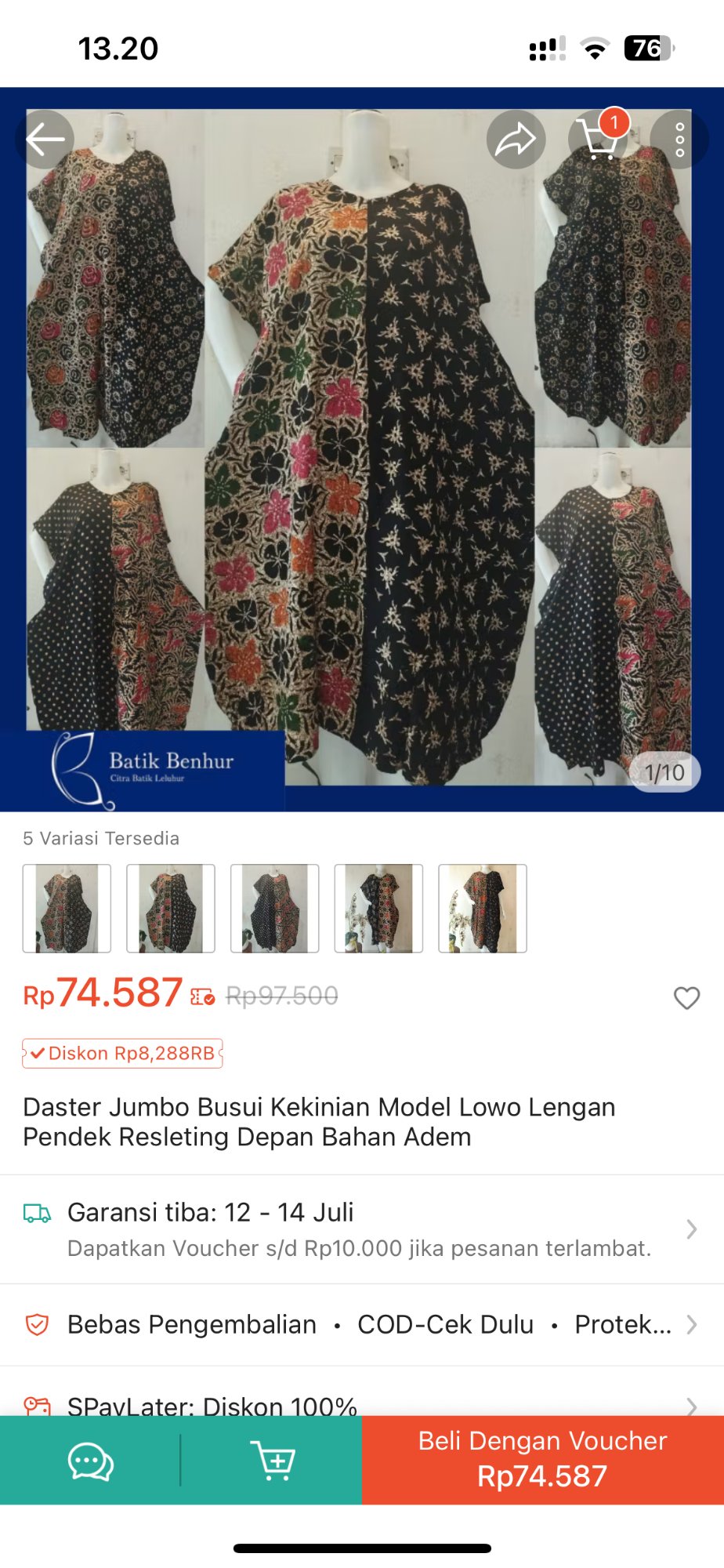
Batik Benhur Shopee PDP before optimization — mannequin photography
Insight All product images use headless mannequins on a neutral background — no human reference, no lifestyle context, no feature highlighting. The visual provides zero emotional connection and minimal product clarity. This is a structurally trust-negative presentation for a fashion category where fit, drape, and wearability are the primary purchase considerations.
Strategic Diagnosis

"The product was not the problem. The visual and presentation system surrounding it was actively preventing conversion. Fixing the funnel was equivalent to unlocking suppressed demand."
03

Research & Insights

🔍 Competitive Benchmarking
Analyzed top-performing sellers in the Shopee women's fashion category. Identified systematic patterns: real model photography, high-brightness thumbnails, structured feature overlays, and clear "why buy" messaging within the first frame. These sellers were not winning on price — they were winning on presentation trust.
📊 Funnel Diagnostics
Mapped the full conversion funnel using Shopee analytics and ad platform data. CTR below 2% indicated a thumbnail failure at impression level. ATC below 9% revealed a trust collapse on the PDP — before any purchase consideration. The funnel was broken at two distinct stages simultaneously.
👥 Buyer Psychology Analysis
Through category behavior observation and seller community research, identified that fashion buyers on Shopee rely on contextual visualization (model wearing the product) as a primary risk-reduction mechanism. Mannequin photos fail this test — they provide shape without the critical fit and lifestyle reference that buyers need to commit.
📱 Platform-Specific Behavior
Shopee's feed operates in a high-density, high-competition context. Thumbnails compete directly side by side. In this environment, brightness, human presence, and clear feature hierarchy are not aesthetic choices — they are functional requirements for winning attention and generating clicks.
📸
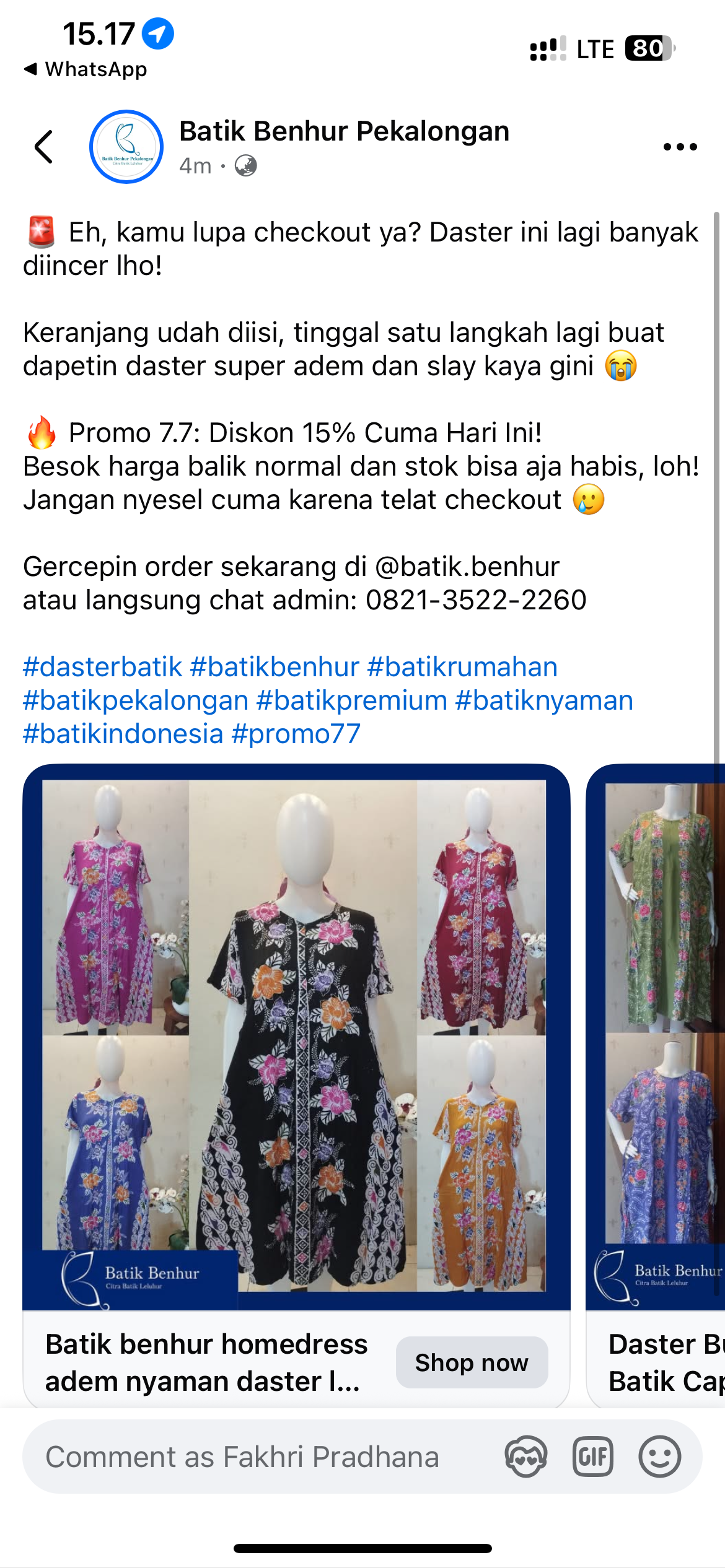
Evidence: Meta CPAS Retargeting Ad — Initial Campaign Creative This screenshot shows an early Meta CPAS retargeting ad running against Shopee catalog audience. Note the mannequin-based creative being served in a social feed context — the same trust gap present on Shopee is replicated across channels.
Batik Benhur Meta CPAS ad with mannequin photography
Insight The retargeting ad uses mannequin images in a Facebook/Instagram social feed — a high-competition context where human relatability is essential for thumb-stop and conversion. The FOMO copy ("kamu lupa checkout?") is strategically correct, but undermined by low-trust creative. This gap between copy intent and visual execution explains why early CPAS ATC was low before the visual overhaul.
✗ What Was Missing
Mannequin = zero emotional or fit reference
No feature callout or benefit overlay
Muted palette = low scroll-stop power
No "why this over competitors" signal
No validated SKU focus — spread too thin
✓ What Top Competitors Did
Real model with lifestyle context in frame 1
High-brightness, mobile-optimized lighting
Structured text overlay: fabric, fit, use-case
Clear brand identity across all thumbnails
Deep product-category knowledge in copy
04

Hypothesis

Before any execution, the intervention was formulated as a testable hypothesis — enabling objective measurement of whether the changes produced the expected outcome.

IF we execute these interventions:
Replace mannequin photography with AI-enhanced real model visuals to introduce human reference and emotional fit cues
Redesign art direction with high-brightness, high-contrast color palette optimized for Shopee mobile feed
Implement structured feature text overlays: fabric type, size range, and primary use-case in each thumbnail
Clarify the value proposition ("why buy this") within frame 1 of every product listing
Run weekly sprint iterations with performance data (CTR, ATC, CVR) governing each creative decision
→
THEN we expect these outcomes:
CTR lifts to above-category benchmark as visual trust and thumbnail quality improve scroll-stop rate
ATC rate rises as improved PDP presentation reduces perceived purchase risk and increases intent
CVR follows as the full funnel operates in a coherent, trust-building sequence from impression to order
Winning SKUs surface through comparative performance data, enabling focused resource and budget allocation
A documented, replicable framework emerges that can be applied to new SKU launches with compressed timelines
05

Strategy & Framework

Three interlocking methodologies governed execution: Design Thinking for problem framing, a Growth Experiment Loop for iterative validation, and Agile Sprints for operational velocity.

Design Thinking
EEmpathize — buyer psychology & category behavior
DDefine — funnel gaps, root cause, trust signals
IIdeate — creative & structural interventions
PPrototype — visual assets, PDP structure, copy
TTest — deploy, measure against KPIs, iterate
Growth Experiment Loop
HHypothesis — specific, measurable prediction
BBuild — minimum viable creative execution
MMeasure — CTR, ATC, CVR, ROAS tracking
LLearn — what moved the needle and why
→Repeat with refined hypothesis
Agile Weekly Sprints
W1Full visual production & publish
W2Initial data signal read — identify movers
W3Ads activation (Shopee + Meta CPAS)
W4+Iterative optimization by SKU performance
W8200+ sales + SKU validation complete
06

Execution Process

Week 1 — Production Sprint
Full Visual System Overhaul
Replaced all mannequin images with AI-enhanced model visuals across every active SKU. Rebuilt art direction with high-saturation palette. Implemented structured text overlay system. Rewrote product titles and descriptions with keyword structure and clear feature hierarchy. All changes deployed simultaneously to establish a clean measurement baseline.
Week 2 — Baseline Measurement
First Signal Detection
Monitored Shopee analytics for organic CTR shifts, session depth, and early ATC behavior without paid amplification. Identified which SKUs attracted clicks organically — early indicator of relative product-market fit. Used this data to prioritize ad budget allocation for the following sprint rather than spreading spend uniformly.
Week 3 — Paid Activation
Shopee Ads + Meta CPAS Launch
Activated Shopee internal ads on validated SKUs. Launched Meta CPAS to retarget Shopee catalog audiences via Instagram and Facebook. CPAS immediately showed strong ATC signal at 18–20% peak — validating creative direction and confirming audience-product alignment. Began weekly bidding adjustments based on cost-per-ATC data.
Weeks 4–7 — Iterative Optimization
Sprint Review Cycles
Weekly sprint reviews against CTR, ATC, and CVR benchmarks. Continuously refined underperforming SKU creatives. Identified One Set Batik as the primary winning product through comparative performance data. Reallocated budget toward highest-converting SKU-audience combinations. Used CPAS signals to inform Instagram organic content strategy in parallel.
Week 8 — Milestone + Framework Extraction
200+ Sales Achieved · Framework Codified
Crossed 200+ cumulative orders. CVR stabilized at 3–4%, ATC at ~12%, CTR holding at 4–6%+. Documented the complete visual system, testing cadence, and SKU validation methodology into a replicable launch framework for future SKU expansion.
07

Design Evolution & Visual Strategy

The visual overhaul was not a cosmetic decision — it was the primary conversion intervention. Every design choice was grounded in a specific behavioral hypothesis about how buyers in this category make purchase decisions.

✗ Before — Mannequin System
Before: Shopee PDP with mannequin photos
✗Headless mannequin provides no emotional or fit reference for the buyer
✗Neutral background with muted, low-saturation product colors — fails to stop scroll
✗No text overlay — product features entirely absent from thumbnail
✗No value proposition or differentiation signal visible at a glance
✗Collage format of multiple mannequin views reduces per-image impact
✓ After — Model + Overlay System
After: Shopee store with model photos and feature overlays
✓Real model wearing product — activates relatability and fit visualization
✓High-saturation palette with bright lifestyle backdrop — dominant in feed
✓Structured feature overlay (Rayon Premium, Adem Ayem, All Size) — communicates value instantly
✓Premium Quality badge + Promo label — social proof and urgency in one frame
✓Consistent brand visual system across all SKUs — builds trust through coherence

Art Direction Decisions

👤
Mannequin → AI-Enhanced Real Model
The transition from mannequin to human model is a trust architecture decision, not a cosmetic upgrade. Fashion buyers on Shopee need to see how a garment drapes, fits, and feels in context. Human models activate pattern recognition — buyers can envision themselves wearing the product. Mannequins break this cognitive link entirely. AI model enhancement allowed scaling this transition without incremental photography cost per SKU.
🎨
Color & Brightness Optimization
Shopee's mobile feed is a high-density competitive grid. Thumbnail attention is won and lost in milliseconds. Muted, low-saturation images that look fine in isolation perform poorly in-feed because they are visually recessive against competitors using brighter palettes. Color correction and background optimization were designed specifically for feed-context dominance, not isolated product aesthetics.
📝
Feature-Based Text Overlay System
Buyers scan thumbnails before clicking. If the product's key benefits (fabric quality, size inclusivity, comfort proposition) are not visible at thumbnail level, they are not surfaced until after click — after which many buyers have already moved on. The overlay system was designed to front-load the value proposition at the impression stage, reducing friction between impression and click.
🏆
Visual Hierarchy & Social Proof Signals
Premium Quality badge, Promo indicator, and structured layout create a hierarchy of information that communicates multiple trust signals in a single frame: product quality, promotional value, and brand investment. This is marketplace-first design thinking — designing for the scan behavior of a Shopee buyer, not for a lookbook aesthetic.

Design Principles Applied

🤝
Trust Building
Human models + feature clarity = reduced purchase risk
👗
Relatability
Real people wearing real products in real contexts
📐
Visual Hierarchy
Structured information priority in every frame
🛍️
Marketplace-First
Designed for Shopee scan behavior, not lookbook aesthetics

Design → Conversion Impact

CTR Before
<2%
CTR After
4–6%+
ATC Before
<9%
ATC After
~12%
CVR Before
~0%
CVR After
3–4%
Design → Business Principle

"Every visual decision had a measurable business hypothesis attached to it. Design was not a deliverable — it was an experiment variable."

08

Funnel: Before vs After

All metrics reflect iterative improvement over 8 weeks. The stable "after" state represents a sustained conversion floor — not a peak — achieved through consistent sprint-based optimization.

Before — Baseline State
CTR (Feed)
<2%
Add-to-Cart Rate
<9%
Conversion Rate
~0%
Meta CPAS ATC
Low / Untracked
Daily Sales
0
vs
After — Stable State (Week 8+)
CTR (Feed)
4–6%+ (stable)
Add-to-Cart Rate
~12% (stable)
Conversion Rate
3–4% (stable)
Meta CPAS ATC
18–20% (peak)
Cumulative Sales
200+ in 8 weeks
Funnel Interpretation

"All three funnel stages improved simultaneously — CTR, ATC, and CVR. This pattern indicates the intervention addressed the systemic root cause, not an isolated symptom."

09

Results: Growth Story

Sales Volume
↑ ∞
200+
From zero to meaningful traction in 8 weeks. Revenue baseline established from a complete standstill.
CTR — Stable State
↑ 3× lift
4–6%
From <2% baseline. Sustained above-category benchmark driven by visual system overhaul.
Conversion Rate
↑ Sustained
3–4%
Stabilized at healthy e-commerce benchmark. Iterative improvement, not a one-time spike.
Add-to-Cart Rate
↑ 33%+ lift
~12%
From <9% baseline. Reflects improved PDP trust and reduced purchase risk perception.
Meta CPAS ATC Peak
✓ Validated
18–20%
Cross-platform signal confirming creative resonance with intent-bearing audiences on Facebook and Instagram.
SKU Validation
✓ Winner Found
1 Hero
One Set Batik identified as the winning SKU through comparative performance data. Budget and production refocused accordingly.
📸
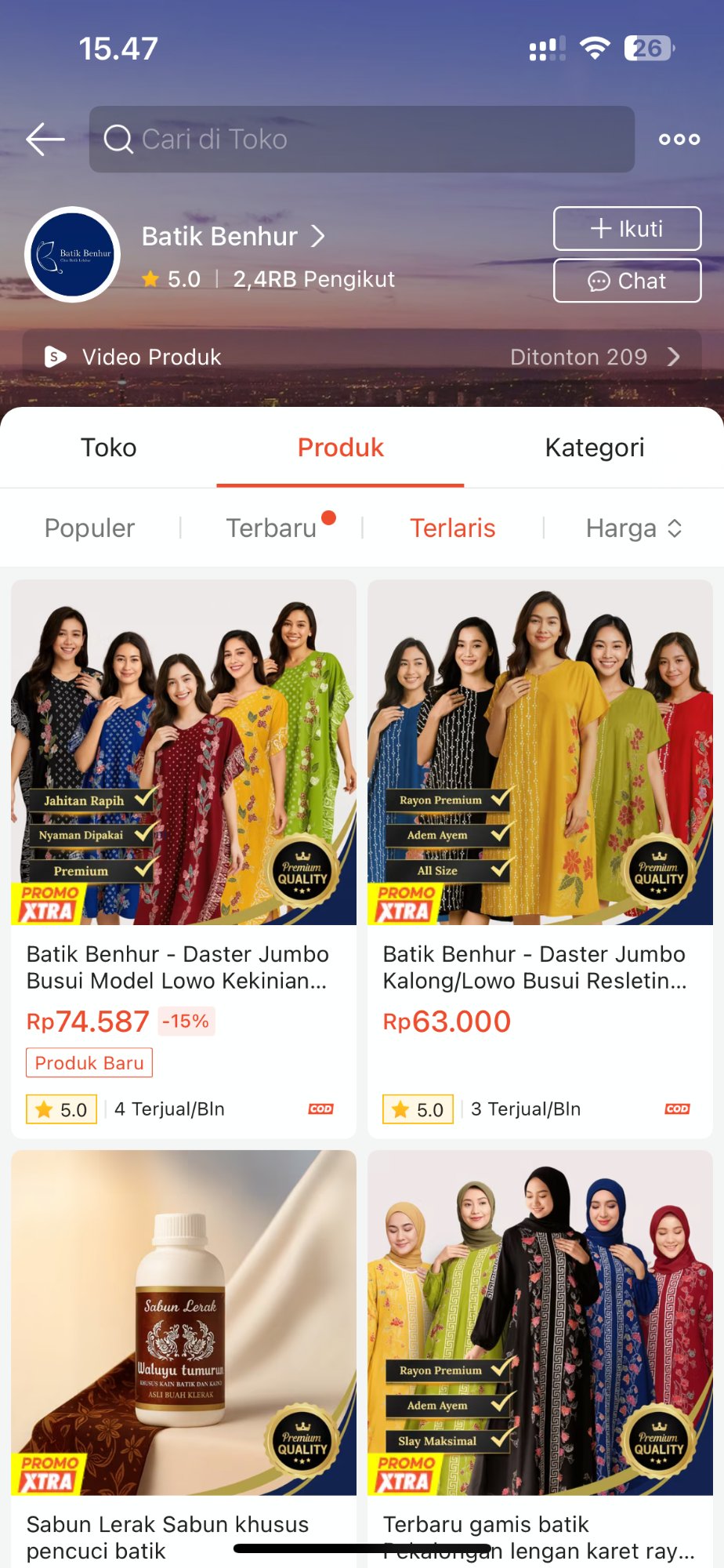
Evidence: Shopee Store Page — Post-Optimization State This screenshot captures the Batik Benhur Shopee storefront after the full visual overhaul. It serves as direct visual evidence of the design system implementation and the resulting store health metrics — 5.0 rating and 2.4K followers.
Batik Benhur Shopee store after optimization — model photos with feature overlays
Insight The after state demonstrates the full visual system in execution: real model photography across all SKUs, structured feature overlays (Rayon Premium, Adem Ayem, Jahitan Rapih, All Size), Premium Quality badge, and Promo XTRA label. The store shows 5.0 rating and 2.4K followers — a social proof signal that compounds conversion trust over time. The visual consistency across product cards creates a coherent brand identity that signals operational professionalism to buyers.
10

Business Impact

Revenue Baseline Established
The brand moved from zero viable revenue to a sustainable, growing trajectory. Revenue is now driven by repeatable, optimized processes — making it defensible and scalable rather than dependent on one-off promotional activity.
Capital Allocation Efficiency
Ad spend is concentrated on validated SKUs with proven audience-product fit. This materially reduces wasted budget and increases marginal return per spend unit — a direct outcome of data-driven SKU prioritization rather than uniform budget distribution.
Production Decision Intelligence
With a clear winning SKU identified through performance data, production planning is now strategic rather than speculative. Inventory, variation selection, and restocking decisions are tied to actual demand signals rather than intuition or historical assumptions.
Replicable Visual Launch System
The redesigned photography framework, art direction guidelines, and overlay template system are reusable across the full product catalog — reducing time-to-launch for new SKUs and maintaining brand visual consistency at scale without incremental design cost.
11

Key Learnings

01
Funnel Optimization Before Traffic Scaling
The reflex to increase ad spend when sales are low is frequently the wrong move. In this case, scaling traffic into a broken funnel would have amplified burn rate, not revenue. The correct sequence is: diagnose the funnel, fix the leak, then scale. This discipline is a core operating principle in growth product work.
02
Visual Trust Is the Primary Conversion Lever in Fashion Marketplace
In a category where physical product touch is absent, buyers construct perceived quality entirely through visual presentation. The mannequin-to-model transition was not cosmetic — it was a structural trust upgrade. The ATC improvement confirmed this directly: PDP trust and purchase intent are tightly coupled.
03
Iterative Testing Compresses Learning Cycles
Weekly sprint cadence created a structured feedback loop that accelerated the time between hypothesis and validated insight. Each iteration built on the previous, compounding learning velocity. The result was a stable high-performing funnel in 8 weeks rather than months of trial-and-error without a structured testing framework.
04
Cross-Platform Signals Strengthen Decision Confidence
The 18–20% CPAS ATC peak on Meta provided external validation of the creative direction independently of Shopee analytics. Using multiple data sources to triangulate the same hypothesis reduces the risk of optimizing against platform-specific noise and builds more confident, defensible product decisions.
05
SKU Breadth Without Validation Is a Resource Trap
Operating across many unvalidated SKUs distributes creative, ad budget, and operational attention too thinly to generate meaningful signal on any individual product. Identifying the winning product early through data — then concentrating resources — is the only efficient path to scaling a multi-SKU catalog.
12

Scalability & Future Plan

Scalable Framework for New SKUs
01 Apply validated visual system (model photography, overlay template, art direction) to each new SKU from day one — eliminating the baseline trust deficit that cost weeks at launch.
02 Run micro-budget test campaigns (Shopee Ads + CPAS) in W1–W2 to generate comparative CTR and ATC signal before committing full budget allocation.
03 Establish SKU-level performance dashboard tracking CTR, ATC, CVR as standard — enabling faster winner/loser identification and resource rebalancing.
04 Implement tiered budget structure: hero SKU receives 60–70% of spend, test-stage SKUs share the remainder. Rebalance on a bi-weekly sprint cadence.
05 Framework applies equally to new marketplace channels (Tokopedia, TikTok Shop) — the core principle of funnel diagnosis before traffic scaling is platform-agnostic.
If I Were to Repeat This Engagement
R1 Deploy A/B thumbnail concept testing in Week 1 alongside the full visual overhaul — not sequentially. Parallel testing would have surfaced winning creative direction faster.
R2 Structure ad testing budget with explicit holdout logic from the start — to isolate creative lift from audience targeting effects and produce cleaner signal.
R3 Set a strict Week 3–4 go/no-go decision gate per SKU — preventing underperformers from consuming creative and budget resources beyond the validation window.
R4 Introduce a structured review seeding strategy earlier in the cycle to compress the social proof gap — the trust deficit window in weeks 1–3 was a meaningful CVR suppressor.
R5 Document the brand tone-of-voice and visual guidelines in a shareable brief format — enabling faster onboarding of any production or creative support without quality degradation.
Product Manager Portfolio · Closing Statement

I solve funnel problems.
I design systems that scale.

This was not a visual redesign project. It was a funnel optimization strategy executed through a design lens. The visual changes were the implementation layer of a hypothesis — not the strategy itself. The strategy was: identify where the funnel breaks, form a specific testable intervention, execute, measure, and repeat.

The resulting framework is platform-agnostic and SKU-agnostic — the same logic that moved Batik Benhur from zero to 200+ sales applies to any marketplace, any product category, any brand with a conversion problem. That's the output I care about: not a single campaign, but a repeatable system.

🧠
Product
Thinking
📈
Growth
Orientation
🎨
Design
Execution
📊
Data-Driven
Decisions
Funnel Optimization Growth Experimentation Design Thinking SKU Validation Marketplace Strategy Shopee · Meta CPAS Agile Sprints Visual Strategy